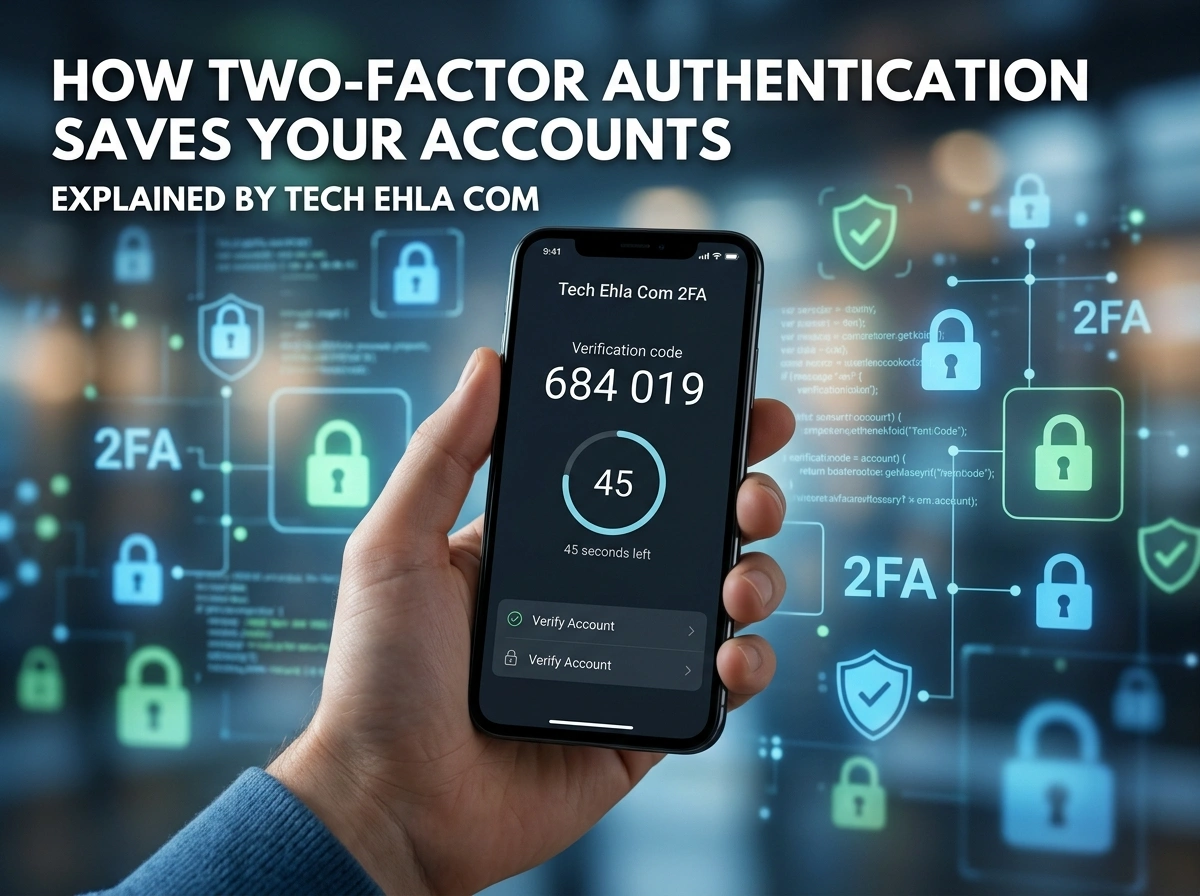
Your email, bank, and social media accounts hold more of your life than you might realize. One weak password could hand a stranger the keys to all of it. That’s exactly why two-factor authentication (2FA) has become one of the smartest security habits you can build. In this guide from tech ehla com, you’ll learn what 2FA is, how it works, and why it deserves a spot on every account you own.
What Is Two-Factor Authentication?
Two-factor authentication is a security method that requires two separate pieces of proof before you can log in. Instead of relying only on a password, it adds a second layer of verification.
Think of it like a bank vault. The password is the combination lock, and the second factor is the physical key. A thief who steals one still can’t get inside without the other.
Security experts group these proofs into three categories:
- Something you know — a password or PIN.
- Something you have — a phone, app, or hardware key.
- Something you are — a fingerprint or face scan.
True 2FA combines two of these different categories, which makes unauthorized access far harder.
Why Passwords Alone Are Not Enough
Passwords have protected accounts for decades, but they were never designed for today’s threats. Here’s why relying on them alone is risky.
People Reuse Passwords
Most Americans juggle dozens of online accounts, so many reuse the same password everywhere. When one site suffers a breach, attackers try those stolen credentials across other platforms. This trick, called credential stuffing, works alarmingly often.
Passwords Get Stolen Constantly
Data breaches expose billions of login details every year. Phishing emails, fake login pages, and malware all harvest passwords quietly. Once your password is out there, it can circulate on dark web marketplaces for years.
Weak Passwords Are Easy to Guess
“123456” and “password” still rank among the most common choices. Automated tools can crack simple passwords in seconds using brute-force attacks.
With 2FA turned on, a stolen password becomes almost useless. The attacker still needs that second factor, which stays in your hands.
How Two-Factor Authentication Works, Step by Step
The process is simple and takes only a few extra seconds once it’s set up.
- Enter your username and password. This is your first factor, something you know.
- The system requests a second factor. After confirming your password, the service asks for additional proof.
- Provide the second factor. You might type in a code from an app, tap a notification, insert a hardware key, or scan your fingerprint.
- Access is granted. Once both factors check out, you’re in.
If someone tries to log in with just your password, they’ll hit a wall at step two. Many services also alert you when a login attempt happens, giving you an early warning that something’s wrong.
The Different Types of Two-Factor Authentication
Not all 2FA methods offer the same level of protection. Here’s a breakdown of the most common options.
SMS Text Codes
You receive a one-time code by text message and enter it to log in. This method is easy and widely available.
The downside? Attackers can hijack phone numbers through “SIM swapping,” where they trick a carrier into transferring your number to their device. SMS is still far better than no 2FA, but it’s the weakest of the bunch.
Authenticator Apps
Apps like Google Authenticator, Microsoft Authenticator, and Authy generate time-based codes that refresh every 30 seconds. The codes live on your device, so there’s no text message to intercept.
Authenticator apps offer a strong balance of security and convenience, making them a favorite for everyday users.
Hardware Security Keys
These are small physical devices, often USB or NFC based, that you plug in or tap to confirm your identity. Popular examples include YubiKey and Google Titan.
Hardware keys resist phishing extremely well because they verify the actual website before responding. They’re the gold standard for high-value accounts, though they cost money and can be lost.
Biometrics
Fingerprint scans, facial recognition, and voice ID fall into this category. Biometrics feel effortless since your body is the key.
Modern smartphones and laptops build these features right in, so many people already use them daily without a second thought.
Real-World Examples of How 2FA Stops Breaches
The value of 2FA becomes obvious when you look at real situations.
The reused password scenario. Imagine your streaming service gets breached and your email-password combo leaks. Because you use that same password for your bank, attackers try it there too. Without 2FA, they walk right in. With 2FA enabled, the bank sends a verification prompt to your phone, and the attempt fails.
The phishing attack. You click a convincing email link and unknowingly type your password into a fake page. The attacker now has your credentials. But your authenticator app or hardware key blocks the login because the second factor never reaches them.
The corporate wake-up call. Major companies have publicly credited mandatory 2FA with dramatically cutting account takeovers. After Google rolled out 2FA to its users, it reported a steep drop in successful phishing attacks. Businesses across the country now treat 2FA as a baseline requirement for protecting customer data and staying compliant with security regulations.
These stories share one theme: the password fell, but 2FA held the line.
Best Practices for Enabling Two-Factor Authentication
Turning on 2FA is only the start. Follow these tips to get the most protection.
Prioritize Your Most Important Accounts
Start with email, banking, and any account tied to payments. Your email often controls password resets for everything else, so lock it down first.
Choose Stronger Methods When Possible
Use an authenticator app or hardware key over SMS whenever a service offers the choice. Reserve text codes for services that support nothing better.
Save Your Backup Codes
Most platforms give you a set of one-time backup codes when you enable 2FA. Store them somewhere safe and offline, like a locked drawer or a trusted password manager. They’ll rescue you if you ever lose your phone.
Register More Than One Device
Adding a second phone or a spare hardware key means you won’t get locked out if your main device breaks or goes missing.
Pair 2FA With Strong, Unique Passwords
2FA works best alongside good password habits. Use a reputable password manager to create and store long, unique passwords for every account.
Stay Alert to Login Prompts
Never approve a 2FA request you didn’t trigger. If a code or notification shows up out of nowhere, someone may be trying to break in. Change your password right away.
Common Questions About 2FA
Does 2FA slow me down? Only slightly. The few seconds it adds are a small price for keeping intruders out.
What if I lose my phone? Backup codes and a second registered device keep you covered. Set these up before you need them.
Is 2FA really necessary for everyone? Yes. Whether you’re a student, a small business owner, or a retiree, your accounts hold value worth protecting.
Take Action Today
Two-factor authentication is one of the easiest, most powerful steps you can take to secure your digital life. It transforms a single vulnerable password into a two-layer defense that stops the vast majority of attacks cold.
Don’t wait for a breach to teach you this lesson. Open your most important accounts right now, head to the security settings, and switch on 2FA. Start with your email, then work through your bank, social media, and shopping accounts.
For more clear, practical guides on protecting your devices and staying safe online, keep following tech ehla com. Your accounts, your money, and your peace of mind are worth those extra few seconds.