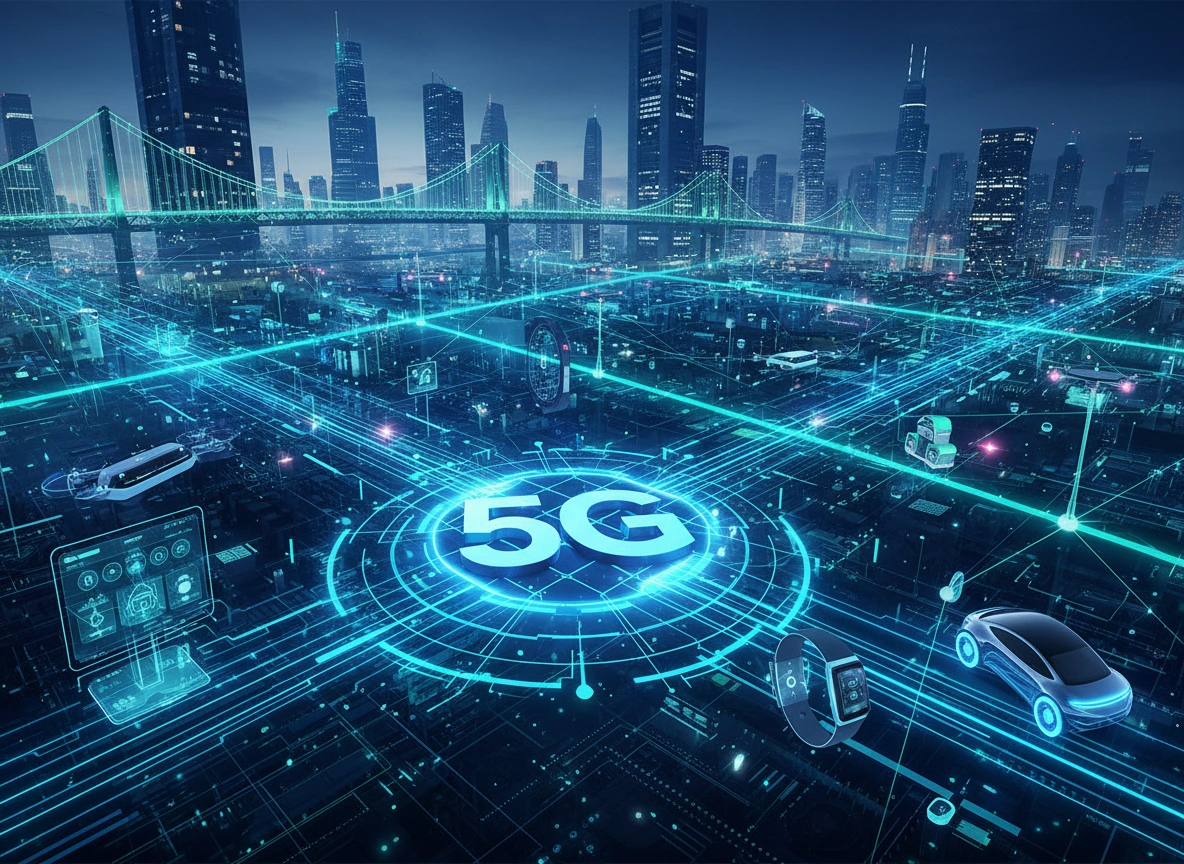
The Internet of Things (IoT) has steadily integrated itself into our daily lives, connecting everything from smartwatches to industrial sensors. This network of physical objects embedded with technology has promised a more efficient and interconnected future. However, the true potential of IoT has often been limited by the capabilities of existing wireless networks. The arrival of 5G, the fifth generation of wireless technology, is set to change that, unleashing a new era of possibilities for IoT devices.
This article will explore the profound impact of 5G technology on the IoT landscape. We will examine the key benefits it brings, such as enhanced speed and reduced latency, and discuss how these advancements are enabling transformative applications like smart cities, autonomous vehicles, and advanced industrial automation. We’ll also consider the challenges and future implications of this powerful combination.
What is 5G and Why Does it Matter for IoT?
5G is not just an incremental upgrade from its predecessor, 4G. It represents a fundamental shift in how wireless networks operate. While 4G focused on delivering faster mobile broadband, 5G is designed to support a vast and diverse ecosystem of connected devices with varying needs. It achieves this through three core characteristics:
- Enhanced Mobile Broadband (eMBB): This provides significantly faster data speeds, with peak rates reaching up to 10 gigabits per second (Gbps). This is crucial for high-bandwidth applications like streaming ultra-high-definition video or augmented reality.
- Ultra-Reliable Low-Latency Communications (URLLC): 5G dramatically reduces latency—the delay between sending and receiving information—to as low as one millisecond. This near-instantaneous communication is vital for mission-critical applications where real-time response is non-negotiable, such as remote surgery or autonomous vehicle control.
- Massive Machine-Type Communications (mMTC): This pillar is specifically designed for IoT. 5G can support up to one million connected devices per square kilometer, a massive increase compared to 4G. This density is essential for deploying large-scale sensor networks in smart cities or industrial settings.
These three pillars work together to create a network that is not only faster but also more reliable, responsive, and scalable. This is precisely what the world of IoT has been waiting for.
Key Benefits of 5G for IoT Devices
The fusion of 5G and IoT creates a synergy that amplifies the capabilities of both technologies. The primary benefits include enhanced connectivity, minimal latency, and greater device capacity, which together unlock unprecedented performance and functionality.
Enhanced Connectivity and Speed
One of the most celebrated features of 5G is its incredible speed. For IoT, this means devices can transmit large volumes of data to the cloud for processing and analysis almost instantly. A smart factory, for example, can have thousands of sensors collecting high-resolution video and operational data. With 5G, this data can be sent and analyzed in real time, allowing for immediate adjustments to the manufacturing process to improve quality and efficiency.
This high-speed connectivity also supports more complex IoT devices. Consider a security camera that uses artificial intelligence to detect threats. 5G allows it to stream high-definition video to a central server for analysis without compression, leading to more accurate and reliable threat detection.
Ultra-Low Latency
Perhaps the most transformative aspect of 5G for IoT is its ultra-low latency. The ability to reduce communication delays to a single millisecond opens the door for applications that were previously impossible. In healthcare, a surgeon could use a robotic arm to perform a delicate operation on a patient miles away, with the robot responding to the surgeon’s movements in real time.
This same principle applies to autonomous vehicles. For a self-driving car to navigate safely, it must communicate instantly with other vehicles, traffic signals, and roadside sensors (a concept known as V2X, or vehicle-to-everything communication). The near-zero lag provided by 5G is critical for making split-second decisions that prevent accidents and ensure smooth traffic flow.
Increased Device Capacity and Network Slicing
Previous network generations struggled with a high density of connected devices. As the number of IoT devices skyrockets—with projections reaching over 29 billion by 2030—networks need to handle this massive scale. 5G’s mMTC capability directly addresses this challenge, allowing millions of devices to operate simultaneously within a small area without degrading network performance.
Furthermore, 5G introduces a powerful concept called “network slicing.” This allows operators to create multiple virtual networks on top of a single physical infrastructure. Each slice can be tailored to the specific needs of an application. For instance, a smart grid might require a slice with ultra-high reliability, while a network of environmental sensors might need a slice optimized for low power consumption and massive device numbers. This flexibility ensures that every IoT application gets the precise level of service it needs to function optimally.
Real-World Applications Powered by 5G and IoT
The theoretical benefits of 5G are already translating into practical, world-changing applications across various sectors.
Smart Cities
The vision of a smart city relies on a vast network of interconnected sensors and devices that manage everything from traffic and energy to public safety and waste management. 5G provides the backbone for this vision. Smart traffic lights can adjust their timing based on real-time traffic data collected from vehicle sensors, reducing congestion and emissions. Connected waste bins can signal when they are full, optimizing collection routes and saving fuel. Public safety can be enhanced through a network of high-definition cameras and sensors that provide first responders with real-time situational awareness during emergencies.
Industrial IoT (IIoT)
In manufacturing and logistics, 5G is fueling the Fourth Industrial Revolution, or Industry 4.0. Factories can deploy thousands of wireless sensors to monitor machinery for predictive maintenance, preventing costly downtime. Automated guided vehicles (AGVs) can navigate factory floors with greater precision and safety thanks to low-latency communication. Supply chains become more transparent and efficient as 5G-enabled trackers provide real-time location and condition data for goods in transit.
Autonomous Vehicles
As mentioned earlier, 5G is a critical enabler for fully autonomous vehicles. The technology facilitates the constant stream of data required for a vehicle to perceive its environment, make decisions, and communicate its intentions to other vehicles and infrastructure. Beyond private cars, this extends to public transportation, trucking, and delivery drones, all of which will rely on 5G’s reliable, low-latency network to operate safely and efficiently.
Challenges and the Path Forward
Despite its immense promise, the widespread adoption of 5G for IoT is not without its hurdles. Building out the necessary infrastructure is a massive and expensive undertaking. The higher frequencies used by 5G have a shorter range and are more easily blocked by obstacles, requiring a denser network of small cell antennas.
Security is another major concern. With billions of new devices connecting to the network, the potential attack surface for cyber threats expands dramatically. Securing every endpoint—from a simple sensor to a complex robotic system—is a monumental task that requires a robust, end-to-end security framework.
Finally, ensuring interoperability and standardization between devices from different manufacturers is crucial for a seamless IoT ecosystem. As the technology matures, industry-wide collaboration will be essential to overcome these challenges.
Conclusion: A Connected Future Realized
The impact of 5G on IoT devices is not merely an upgrade; it is a revolution. By delivering unprecedented speed, near-zero latency, and massive capacity, 5G is breaking down the barriers that have long constrained the potential of the Internet of Things. It is the catalyst that will transform futuristic concepts like fully autonomous cities and hyper-efficient smart factories into everyday reality.
As the rollout of 5G continues to accelerate, we are standing at the threshold of a more connected, intelligent, and efficient world. The synergy between 5G and IoT will drive innovation across every industry, creating new opportunities and fundamentally changing how we live and work. The journey has just begun, but the destination is a future where the digital and physical worlds are seamlessly intertwined.
Please visit this website for more info.